



How to Structure a Podcast Episode: A Simple Template
A podcast episode works a lot like a good meal. A starter tells you what's coming, the main course fills you up, and a clear finish lets everyone know it's time to get up from the table.
Here's the short answer. Most podcast episodes follow three parts: an intro, the main content, and an outro. The intro tells listeners what show this is and what this episode covers. The main content delivers the value, often split into a few segments. The outro thanks listeners and points them to one clear next step.
That's the whole framework. The rest of this guide helps you fill it in for your show.
We'll cover:
- Why episode structure matters
- The parts of a podcast episode
- Podcast segments (with ideas)
- Simple structures you can copy for interview, solo and co-hosted shows
- A sample 30-minute outline
- Common questions about episode length, segments and your first episode
Why episode structure matters
Structure sets expectations. When listeners know how your show flows, they relax into it, and they come back because they know what they'll get.
It also makes your life easier. With a structure in place, you aren't starting from a blank page every week. You know what to write, what to record and where the ad or call to action goes.
Ask yourself: could a regular listener describe how your episodes start and end? If the answer is yes, your structure is doing its job.
Once you've picked your topic and podcast format, choosing a structure gets much easier.
The parts of a podcast episode
Every show is a little different, but most episodes are built from the same handful of parts, sometimes called the elements of a podcast. Some are essential. Some are optional.

- Cold open or teaser (optional). A short clip or a single line from later in the episode that hooks the listener before anything else plays.
- Show intro. Your show name, what the show is about, and who you are. Many shows add a music bumper here.
- Episode intro. What this episode covers and, if there's a guest, a short introduction.
- Main content. The interview, conversation or walkthrough. This is where the value lives, and it can be one long section or several segments.
- Ad or promo break (optional). A sponsor read, or a mention of your own product or service. It can sit at the start (pre-roll), the middle (mid-roll) or the end (post-roll).
- Episode outro. Thank the listener and give one call to action.
- Show outro. A closing line and music that tells listeners the episode is over, plus an optional teaser for what's next.
You don't have to use every part. A short solo show might only need parts 2, 4 and 6.
The intro
Your intro sets the tone for the whole show. Think of it as your elevator pitch.
It can be as simple as your name and the show title. Or you might include:
- A short tagline
- What the show is about and who it's for
- How the show works, for example "the latest news first, then one deep-dive story"
- Who's hosting and who's joining today
If you have a guest, skip the full bio. Pick the two or three details that make listeners care, then get to the conversation. You can also play a short clip from the interview up front to set up what's coming.
The main content
This section delivers the main value. There aren't strict rules about what goes here, and that's the fun part.
It might be:
- An interview with a guest
- A solo walkthrough of a topic or story
- A conversation with a co-host
- A few shorter segments, one after another
Keep it to clean voice recordings, or add music and sound design to bring it to life. Both work. Pick what you can keep up every week.
The outro
Develop a consistent way to end each episode. Always thank people for listening, then ask yourself: where do you want to point listeners, and what would help you most?
Common outro asks include:
- Follow or subscribe to the show
- Share the episode with a friend
- Leave a rating or review
- Join your email list
- Visit a page mentioned in the episode
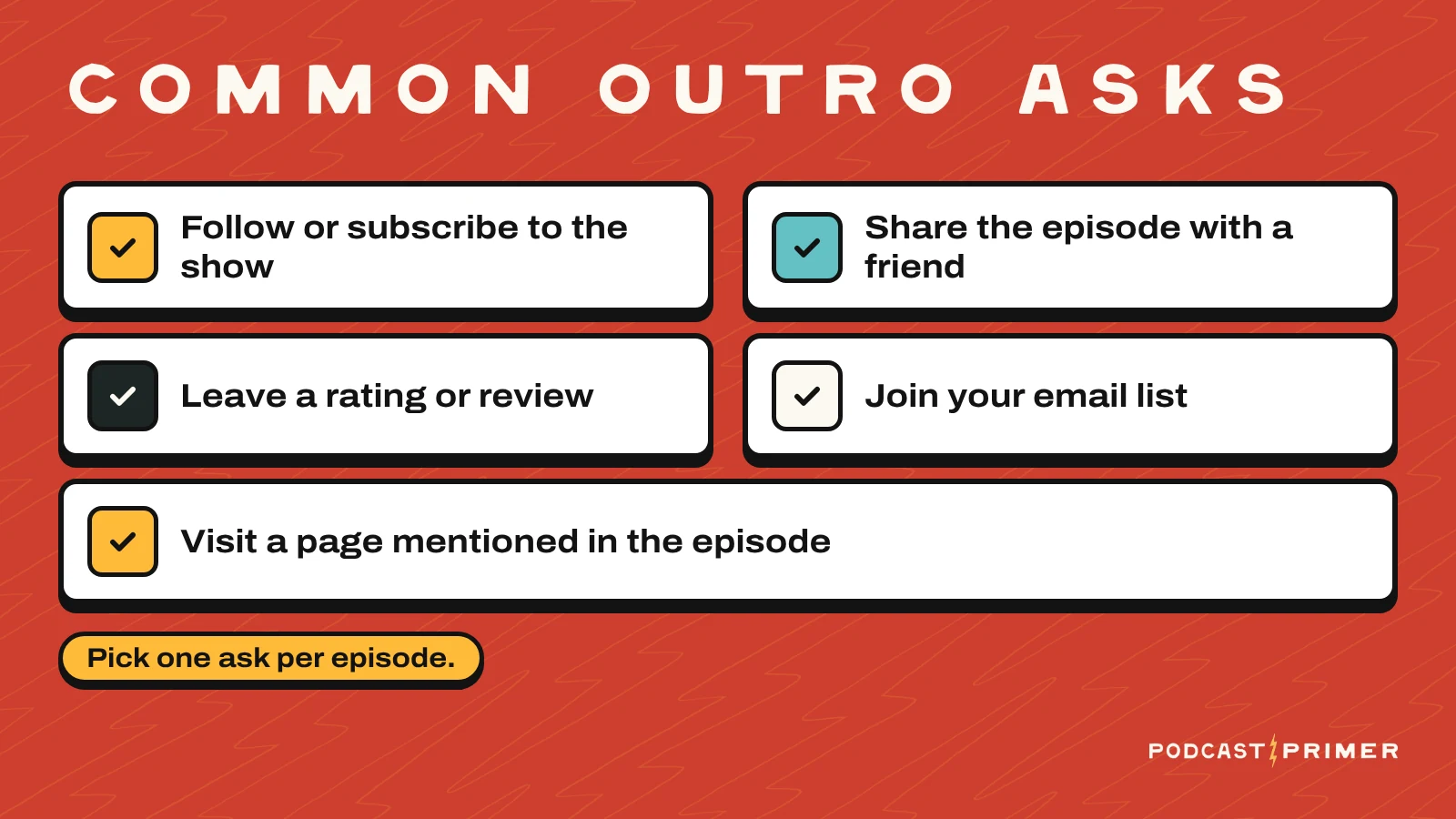
Reality check: pick one ask per episode. A list of five requests is easy to ignore. One clear request is easy to act on.
Put the links you mention in your show notes too. Our podcast show notes template gives each one a home.
Podcast segments (with ideas)
A podcast segment is a recurring section inside the main content with its own purpose, and often its own name. Segments break a long episode into chunks that are easier to follow, easier to plan and easier to clip for social media.
The best tip we can give: create one signature segment that only your show has. A recurring section gives your show its own flavor and gives regulars something to look forward to.
Here are some podcast segment ideas to get you started:
- Listener questions. Answer one or two questions sent in by your audience.
- Lightning round. Quick-fire questions for a guest, the stranger the better.
- News roundup. Two or three stories from your industry this week, with your take on each.
- The one thing. Ask every guest for the single action listeners should take after the episode.
- Case study breakdown. Walk through a real example and what others can learn from it.
- Myth or fact. Pick a common belief in your field and test it.
- Tool of the week. Share one tool, book or resource your listeners would find useful.
- Behind the scenes. A short update on what's happening with you or your business.
- Recap. Close with the three takeaways from the episode.
You don't have to use any of these. Start with one, run it for a few episodes, and keep it if it fits.
Simple structures you can copy
There is no right or wrong structure for your podcast. These templates give you a starting point. Change anything that doesn't fit.
Interview show
- Clip from the interview
- Show intro
- Guest and episode intro
- Interview
- Episode outro and call to action
- Show outro
Solo show
- Show intro
- Episode intro: the topic and what listeners will learn
- Main points, two to four segments
- Recap of the key takeaways
- Call to action and show outro
Narrative or storytelling show
- Cold open: a scene or moment that raises a question
- Show intro
- The story, told in two or three parts
- Where things stand, and a tease for the next episode
- Show outro
Co-hosted show
- Show intro
- Quick catch-up between hosts (keep it short)
- Main topic discussion
- Signature segment
- Call to action and show outro
Once you've chosen a structure, turn it into a reusable outline. Our guide on how to script a podcast walks through that step.
A sample 30-minute episode outline
Here's how the parts can fit into a half-hour episode. Treat the times as a starting point and adjust them to your show.
- 0:00 Cold open (30 seconds)
- 0:30 Show intro (30 seconds)
- 1:00 Episode intro (2 minutes)
- 3:00 Segment one (8 minutes)
- 11:00 Segment two (8 minutes)
- 19:00 Segment three or your signature segment (7 minutes)
- 26:00 Recap of the takeaways (2 minutes)
- 28:00 Call to action and show outro (2 minutes)

Script the frame, outline the middle
Write your intro, your outro and the lines that move you from one segment to the next word for word. Use bullet points for everything in between.
A transition can be a single line, like "That covers the why. Next up, the how." It tells listeners where they are in the episode.
Plan your structure around your schedule
Structure and frequency go together. The more parts and segments your episode has, the longer each one takes to make.
Remember: a structure you can keep up beats an ambitious one you abandon. If you're unsure, start simple and add segments later.
When the first episode of Culpable season one came out, we had five episodes finished. On a weekly schedule, that put us about a month and a week ahead. By the time episode seven came out, we had only just started on episode eight. Without fail, the schedule catches up with you. My rule now: whatever buffer you think you need, double it.
For help picking a cadence you can hold, read our guide on how often to release podcast episodes.
FAQ
How long should a podcast episode be?
There's no set length. Aim for a length that matches the depth of your topic and where your audience listens. A commute or workout show might land between 30 minutes and an hour, while a daily news show might run 10. Once you're live, check the consumption numbers in Apple Podcasts Connect and Spotify for Creators to see how far people listen, then adjust.
What is a segment in a podcast?
A segment is a recurring section of an episode with its own purpose, like a listener Q&A, a news roundup or a lightning round. Segments make episodes easier to follow and easier to plan.
How many segments should a podcast episode have?
Two to four works for most shows. Fewer, longer segments suit interviews. More, shorter ones suit news and variety shows. Start with what you can prepare every week.
How should you structure your first podcast episode?
Use the same structure you plan to use every week, so new listeners get a true sample of the show. Many shows also add a short welcome at the start of episode one that explains who the show is for and what to expect. Keep that part brief and get to the content.
Do you need a script to follow a structure?
No. Many hosts work from a bullet-point outline that follows their structure. A full script helps for solo and narrative shows. An outline is usually enough for interviews.
Your next step
Map your episode using the parts above, then write a simple intro and outro you can reuse every week. You don't need a perfect structure on day one. Record a few episodes, see what feels natural, and refine from there.
Want a head start? Download our free podcast workbook. It includes episode planning pages you can use to map your structure.
Rather hand this off?
Podcast Primer is made by Holistic Media. We plan, record, edit and publish podcasts for brands, so your team only has to show up and talk.
See how it works →