


How to Script a Podcast: Script, Outline, or Talking Points
A podcast script is like a map for a road trip. Some people want every turn written down. Some only want the name of the town. Either way, you get there faster with one than without.
To script a podcast, decide how much to write based on how you record. Solo and narrative episodes usually need a full script. Interviews work best from an outline of questions. Co-hosted conversations need a few talking points. Then read it out loud, cut what sounds stiff, and record.
We'll cover:
- A story about a script nobody could hear
- How much to script for each recording style
- Three templates you can copy: a full script, an interview outline, and talking points
- A short example script
- What to write for each part of an episode
- Seven tips that work for any approach
- How to keep a script from sounding stiff
- Common questions
The script nobody could hear
Back in 2011, I was taking a preaching class in seminary. (Yes, at one point I thought I wanted to be a preacher. Podcasting changed that.) My favorite preacher had a delivery so smooth and conversational that I assumed he winged it every Sunday, maybe with a rough outline at best. When I finally asked about his process, he told me every single word was written down in a complete manuscript. It wasn't always that way. He started with simple outlines and moved to full scripts over years of practice.
A script and a natural delivery can go together. It takes practice, and where you start doesn't have to be where you end up.
Script, outline, or talking points?
There's a whole spectrum between scripting every word and winging it. There is no right or wrong place to land. Your job is to find what works for you and for the way you record.
Not sure which way you record? Our guide to podcast formats covers the three recording styles.
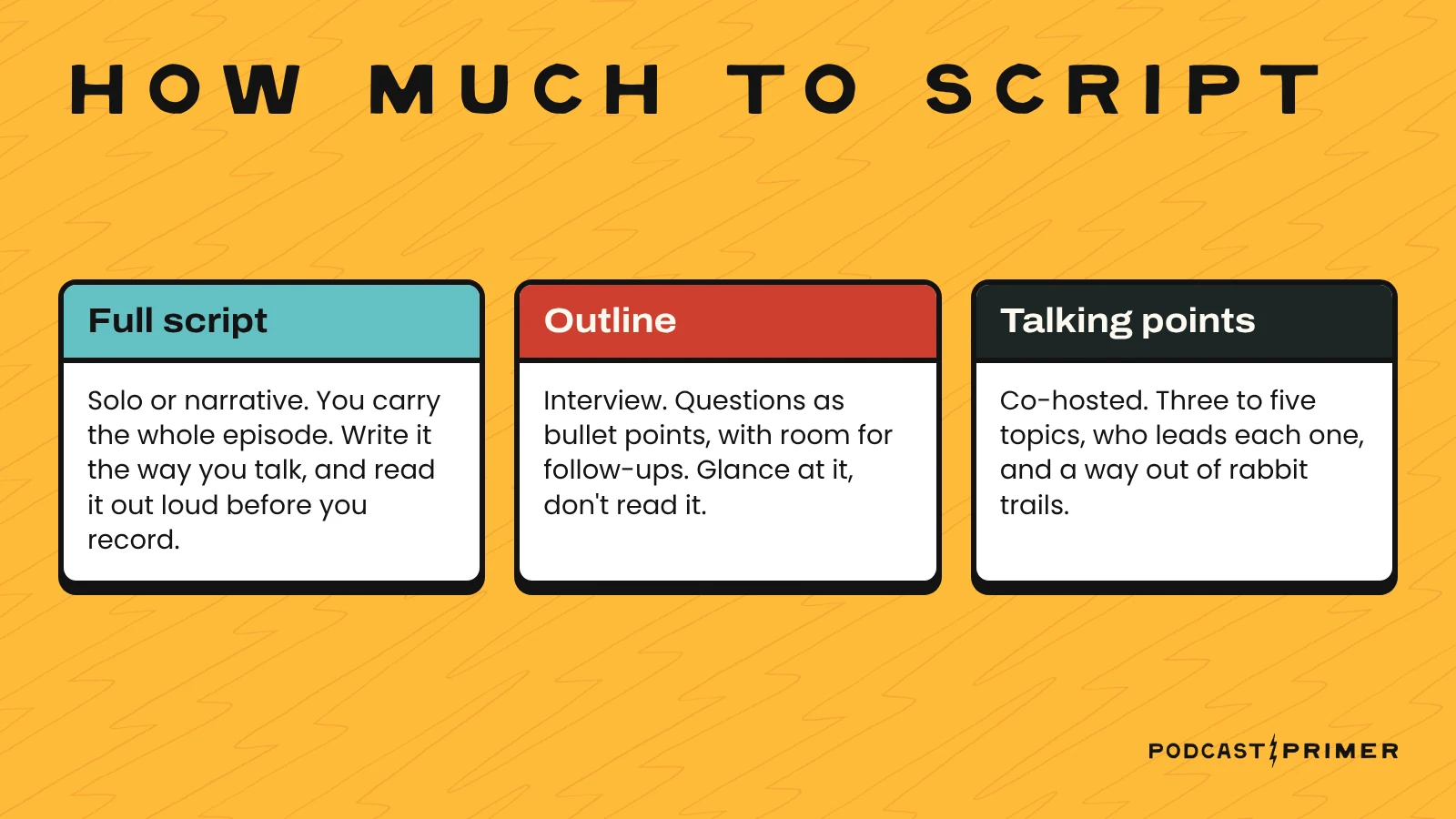
Solo or narrative episodes: a full script
If you're carrying the whole episode on your own, a script gives you structure. True crime shows are a good example. The host's narration is usually fully scripted, while the interviews and field recordings are not.
Interview episodes: an outline
Interviews work best from bullet points or a list of questions. An outline makes sure you ask everything you wanted to ask, and it leaves room for follow-up questions as they come up. Some hosts memorize the outline and only glance at it when they need to.
Co-hosted conversations: talking points
Shows with two or more hosts can be looser. Still, write down a few talking points. They keep you from disappearing down a rabbit trail for 20 minutes.
Podcast script templates you can copy
Pick the one that matches how you record. Change anything that doesn't fit. You don't need to fill in every line.
Full script template (solo or narrative episodes)
- Hook (1 to 2 sentences): the question, story or problem this episode answers.
- Show intro: "This is [show name], the show about [topic] for [who it's for]. I'm [your name]."
- Episode setup: "Today we're covering [topic]. By the end you'll know [what the listener gets]."
- Point 1: the idea, one example or story, and why it matters.
- Transition: one sentence that links point 1 to point 2.
- Point 2: the idea, one example or story, and why it matters.
- Point 3 (optional): same pattern.
- Recap: the two or three things to remember.
- Call to action: one ask.
- Sign-off: "Thanks for listening to [show name]. See you [next release day]."
Interview outline template
- Hook: a short clip or one line about why this guest is worth hearing.
- Show intro: show name, what it's about, who you are.
- Guest intro: name, what they do, and the one reason listeners should care.
- Opening question: something easy that gets the guest talking.
- Main questions: five to seven, in the order you'd like to ask them.
- Follow-ups: "Can you give an example?" and "What happened next?" Keep these on the page so you remember to ask.
- Closing question: the same one every episode works well.
- Where to find the guest.
- Call to action and sign-off.
Talking points template (co-hosted shows)
- Cold open: 30 seconds of real conversation.
- Show intro and what's coming.
- Topic 1: the question you're answering, plus who leads.
- Topic 2: the question you're answering, plus who leads.
- Recurring segment, if you have one.
- One takeaway each.
- Call to action and sign-off.
A short example script
Here's what the first minute of a scripted solo episode can look like. The show is made up. Notice the short sentences and how fast it gets to the point.
Most restaurants don't close because the food is bad. They close because nobody did the math.
This is The Back Office, the show about the business side of running a restaurant. I'm Maria.
Today we're looking at food cost. By the end of this episode you'll know how to work out the food cost of any dish on your menu, and what to do when the number is too high.
Let's start with a plate of pasta.
That's about 75 words, or 30 seconds out loud. A full script keeps that pace for the whole episode.
What to write for each part of an episode
- Intro: who the show is for and what this episode covers. Write this word for word, even if the rest is an outline. It's the part people judge the show by.
- Guest intro: two or three details, not the full bio.
- Transitions: one sentence between sections so the listener knows you've moved on.
- Sponsor or promo: write it out. Reads go better when they aren't improvised.
- Recap: the points to remember, in one breath.
- Outro and call to action: one ask, the same place every episode.
For more on the order these go in, see our guide on how to structure a podcast episode.
7 tips for scripting a podcast
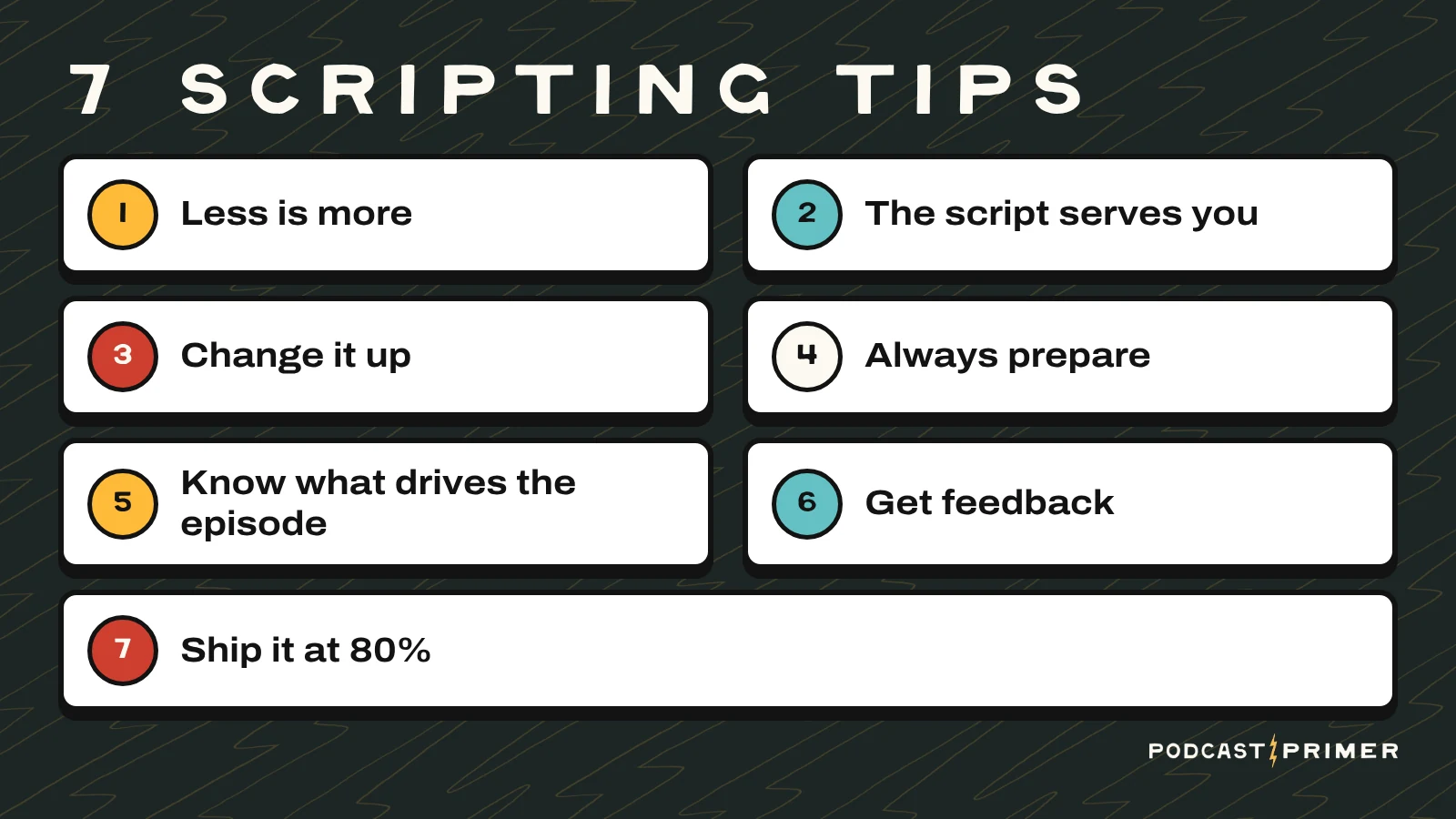
1. Less is more
Ask yourself: "Can I say this with fewer words and still make the point?" Your listeners will thank you for respecting their time.
2. The script serves you
If you feel like you're serving the script, something's off. Change it until recording feels easier, not harder.
3. Change it up
Even with a solid process, some episodes need a different approach. A guest episode and a solo episode won't use the same prep. Feel free to experiment.
4. Always prepare
Prepare for every episode, even if that means jotting down three topics or five questions for your guest. Hitting record with no preparation rarely makes a good episode. A few people can pull it off. Most can't.
5. Know what drives the episode
Ask yourself: are listeners here for your personality or for the topic? If the topic is dry, let your energy carry it. If you have a fascinating guest, let them be the star.
6. Get feedback
Have someone you trust read your script or outline and tell you what they think. Remember: it's one person's opinion. If it doesn't help, ask someone else.
7. Ship it at 80%
As I like to say, 80% out the door is better than 100% in the drawer. It's tempting to spend more time on the last 20% than you spent on the first 80%. That's how episodes never get released.
How to keep a script from sounding stiff
The most common worry about scripting is sounding robotic. A few habits help:
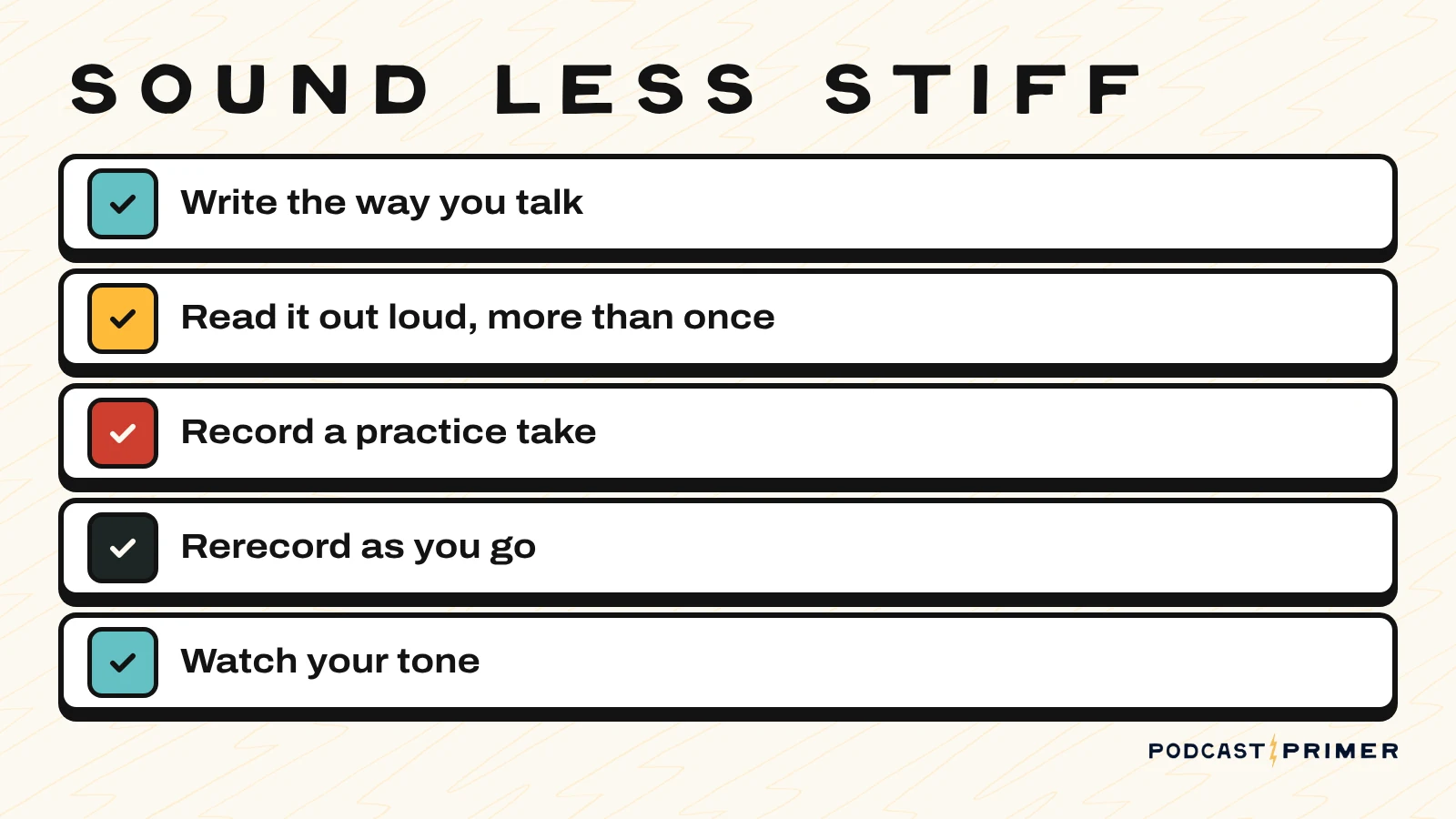
- Write the way you talk. Short sentences. Contractions. Words you'd actually say.
- Read it out loud, more than once. Anything you trip over, rewrite.
- Record a practice take. Listen back and mark the lines that don't sound like you.
- Rerecord as you go. If a line comes out wrong, pause and say it again. You can fix it in the edit.
- Watch your tone. Different sections need different energy.
Your first scripted episode doesn't have to sound perfect. This is a skill, and it gets better with repetition.
Podcast script FAQ
Should I script my podcast word for word?
Only if it helps. Solo and narrative shows often benefit from a full script. Interviews and co-hosted shows usually sound better from an outline or talking points.
How long should a podcast script be?
Most people speak at around 150 words a minute, so a 20-minute solo episode is roughly 3,000 words. Treat that as a starting point and time yourself reading a page out loud.
Do podcasters read from a script?
Many do, at least in part. Narrative and solo shows are often fully scripted. Interview hosts usually script the intro and outro and work from questions in between. The goal is for the listener not to notice.
How do you write a podcast intro script?
Say the show name, who it's for, and what this episode covers, in under 30 seconds. Write it word for word and reuse the same shape every week.
What should a podcast outline include?
An opening line, three to five main points or questions, and how you'll close. Our guide on how to structure a podcast episode walks through each part.
Your next step
Pick the approach that fits your next episode and write the first version today. It doesn't have to be good. It has to exist. Once the episode is recorded, your outline is also most of the way to your show notes.
Want a place to plan it all? The free Podcast Primer workbook walks through this step and the rest of your launch.
Rather hand this off?
Podcast Primer is made by Holistic Media. We plan, record, edit and publish podcasts for brands, so your team only has to show up and talk.
See how it works →