


Podcast Formats: The 3 Recording Styles and How to Pick One
Picking a podcast format is like picking a lane on the highway. It feels like a big commitment, but you can change lanes later.
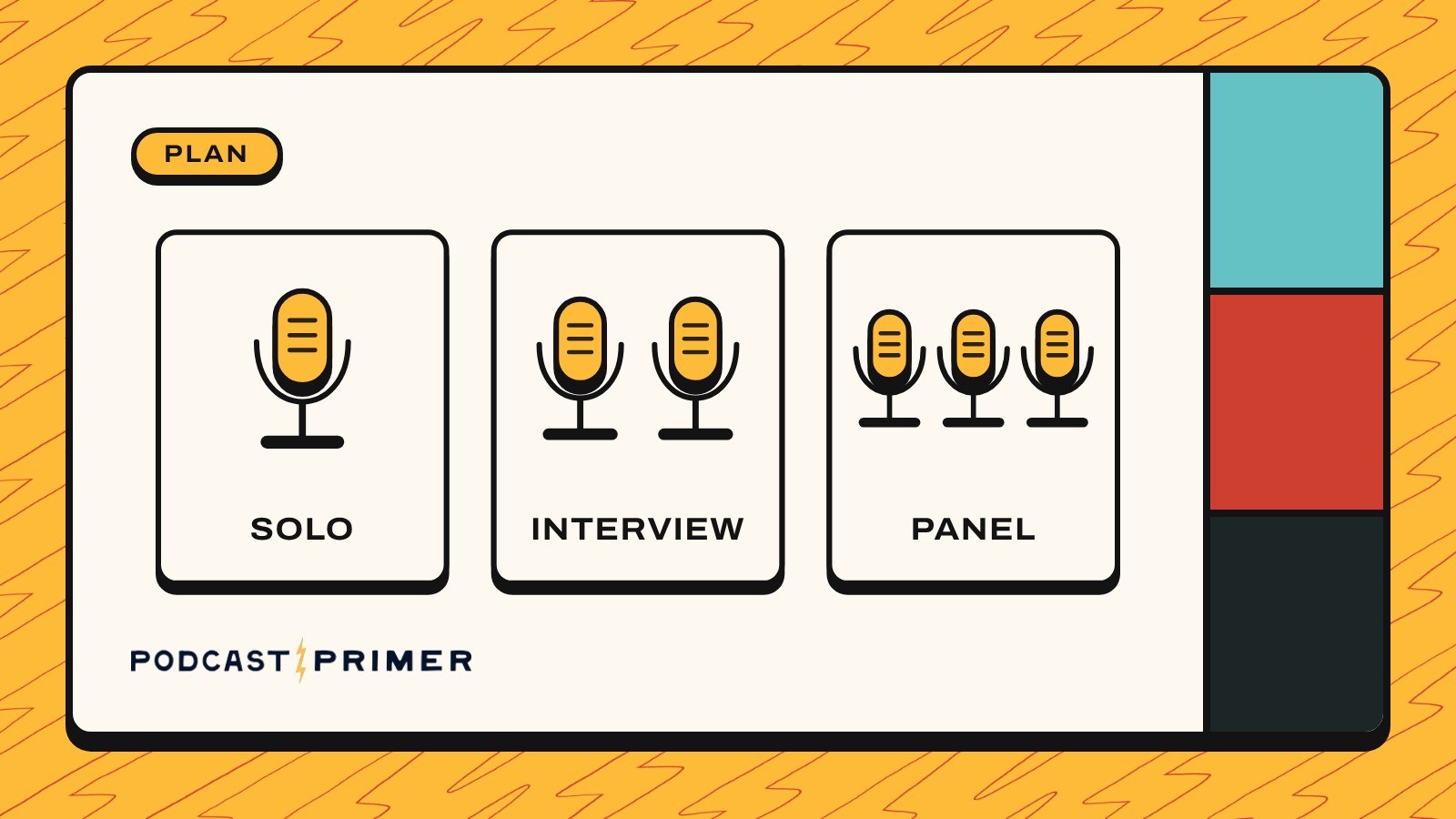
Most podcast formats come down to three recording styles: monologue (one voice), interview (a host and a guest), and conversation (two or more hosts). Pick the one that feels natural, fits your topic, and that you can keep making. Plenty of shows mix them.
We'll cover:
- Why format labels get confusing
- The three recording styles, with examples
- What each one costs you in time, and what you get back
- Where the common format names fit
- How to choose yours
- Which format fits your goal
- Episodic or serialized
- Common questions
Why podcast format labels get confusing
Search for podcast formats and you'll find lists of seven, nine, even twelve types. Solo. Interview. Co-hosted. Panel. Narrative. Hybrid. Most of them are combinations of the same few building blocks.
Podcasting is still a young medium with plenty of room to experiment. That's one of the best things about it, and it's also why shows are hard to sort into neat boxes.
So here's a simpler way to think about formats: recording styles. Every episode is made of one or more of them.
The 3 podcast recording styles
1. Monologue (solo or narrative)
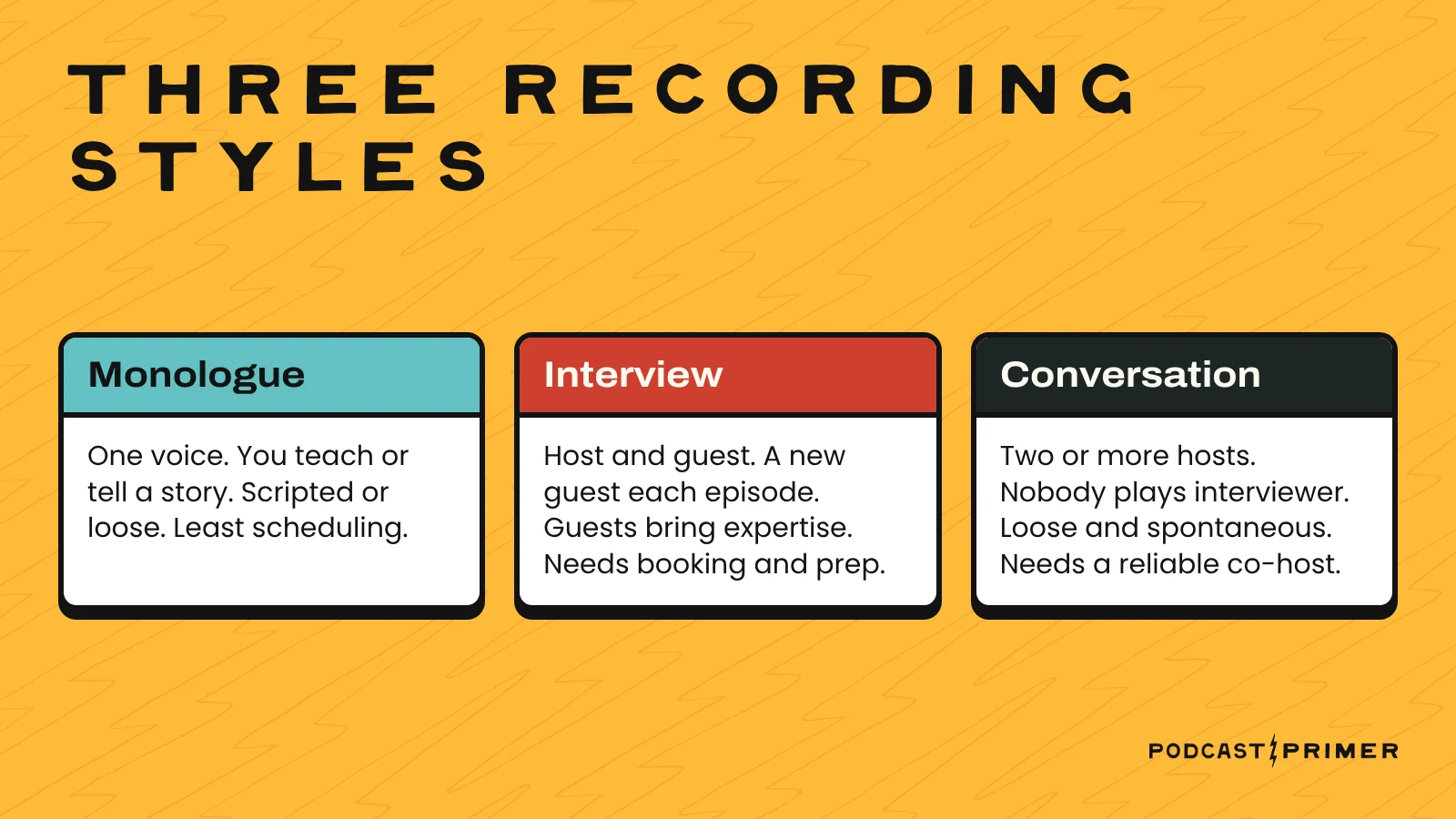
One person speaking into a microphone. It can be scripted or unscripted.
This style works well when:
- You're sharing your own expertise
- You're telling a story or walking listeners through a topic
- You want full control over content and pacing
Huberman Lab is a good example. Some episodes are interviews, but many are Andrew Huberman unpacking one topic on his own.
A monologue doesn't have to be a single recording. Many true crime shows mix host narration with field recordings and interviews.
2. Interview
A host and a guest, usually a new guest each episode, with a common thread tying the episodes together. It's one of the most common styles in podcasting.
It's popular because:
- It takes some pressure off you as the host
- Guests bring their own expertise and audience
- The conversation carries the episode
Many interview shows add short monologue sections where the host comments on the conversation. That commentary is often recorded after the interview. How I Built This is a good example.
3. Conversation (co-hosted)
Two or more hosts covering a topic together. Nobody plays interviewer, so it's looser, with more back-and-forth and debate.
This style works well when:
- You have a reliable co-host or team
- The topic benefits from more than one point of view
- You want a spontaneous feel
Podcast formats compared: effort, pros and cons
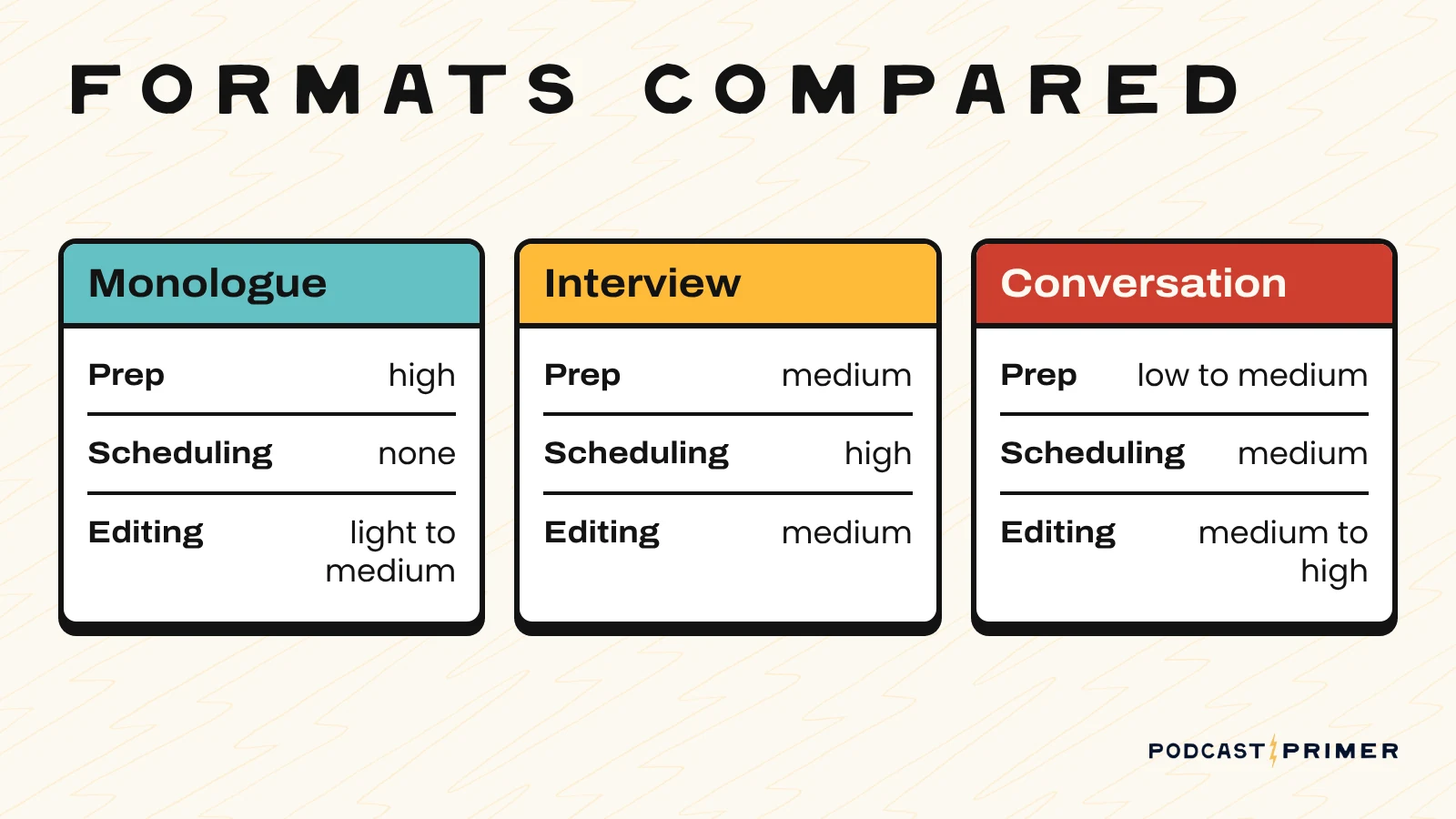
Every style trades one kind of work for another. Here's what to expect before you commit.
Monologue
- Prep: high. You write or outline everything yourself.
- Scheduling: none. You record whenever you're ready.
- Editing: light to medium.
- Good for: teaching, commentary, and building your own authority.
- Watch out for: it's all on you. There's nobody to pick up the energy on a flat day.
Interview
- Prep: medium. You research the guest and write questions.
- Scheduling: high. Booking guests is a job of its own.
- Editing: medium.
- Good for: meeting people in your field, borrowing a guest's audience, and never running out of topics.
- Watch out for: the show can end up sounding like every other interview show. A clear angle and a signature question help.
Conversation
- Prep: low to medium. A few talking points each.
- Scheduling: medium. Two or more calendars every week.
- Editing: medium to high. Crosstalk and tangents take time to clean up.
- Good for: chemistry, opinion, and shows where the hosts are the draw.
- Watch out for: the show depends on every host showing up, and it's the easiest style to let run long.
Remember: the best format on paper is worth nothing if you can't keep making it. Complexity ends more shows than bad ideas do.
Where the common podcast format names fit
These are the names you'll see in most lists of podcast types, and where each one sits.
- Solo podcast: monologue. Hardcore History is one host telling long stories.
- Interview podcast: interview. How I Built This and The Tim Ferriss Show are both built on one guest per episode.
- Co-hosted show: conversation, with the same hosts every week.
- Panel or roundtable: conversation with a rotating group, usually with one host steering.
- Narrative nonfiction or documentary: scripted monologue mixed with interviews and field recordings. Serial is the best-known example. It's the most work per episode of anything on this list.
- Fiction or audio drama: fully scripted, with actors and sound design.
- Call-in or listener Q&A: monologue or conversation built around audience questions.
- Repurposed content: a talk, webinar, sermon or video you already made, released as audio.
- Video podcast: any of the above, recorded on camera as well. Video is a way of publishing a format. It doesn't replace choosing one.
- Hybrid show: any mix of the above.
How to choose your recording style
Ask yourself:
- What feels most natural? If you're comfortable talking on your own, try monologue. If you love asking questions, try interviews. If you're at your best bouncing off someone else, find a co-host.
- What fits the topic? Some topics need one expert going deep. Others are better as a conversation.
- What can you keep up? Solo takes the least coordination. Interviews need booking and scheduling. Conversations need a co-host who shows up.
Reality check: you don't have to pick one style and keep it forever. Plenty of shows mix interview episodes with solo ones.
Which format fits your goal
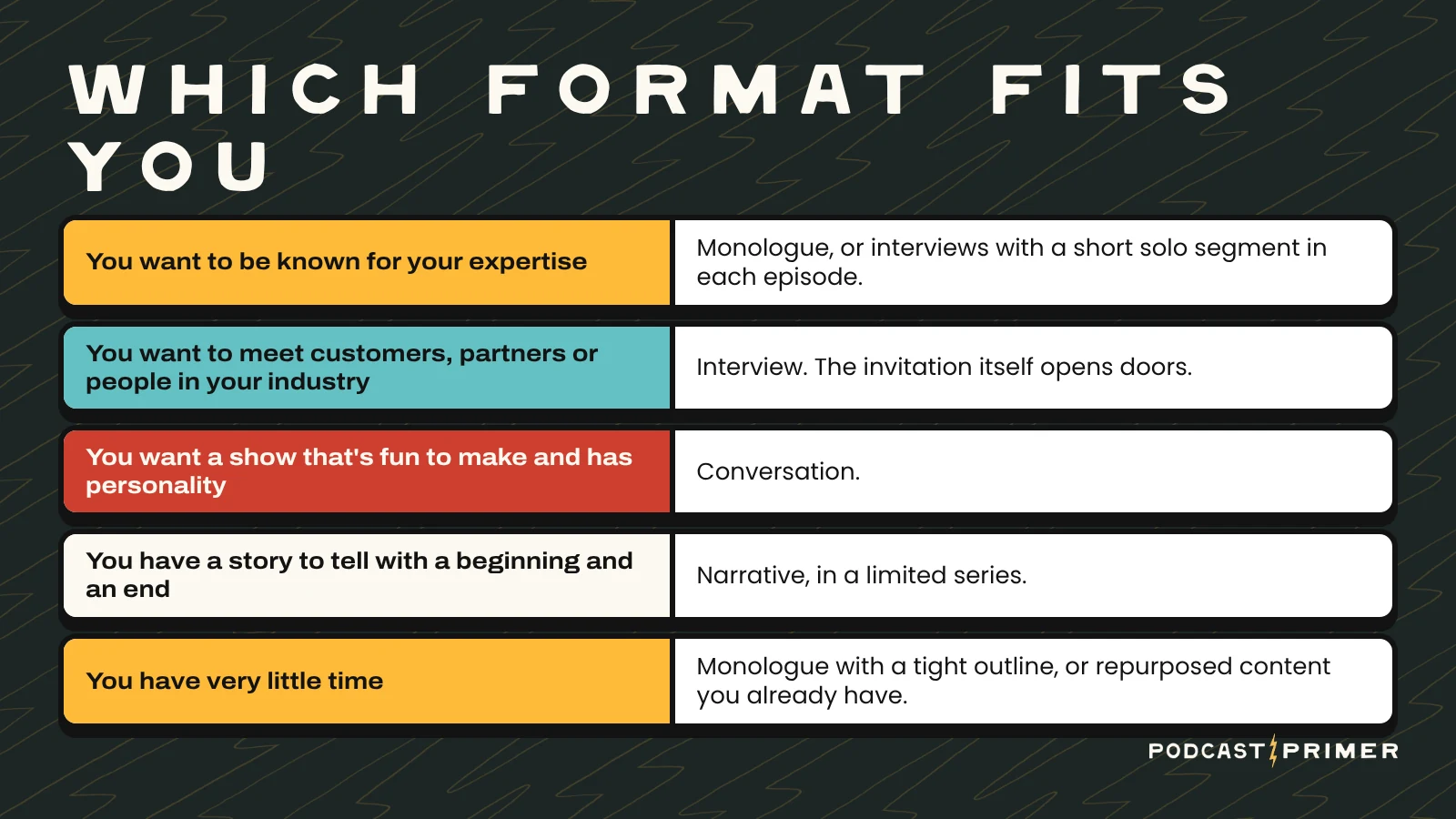
If you're still torn, start from what you want the show to do.
- You want to be known for your expertise: monologue, or interviews with a short solo segment in each episode.
- You want to meet customers, partners or people in your industry: interview. The invitation itself opens doors.
- You want a show that's fun to make and has personality: conversation.
- You have a story to tell with a beginning and an end: narrative, in a limited series.
- You have very little time: monologue with a tight outline, or repurposed content you already have.
For a business show, we usually suggest interviews to start. Guests bring fresh material every week, and each episode builds a relationship that's worth something on its own.
Episodic or serialized?
One more decision, and it's a quick one.
- Episodic: each episode stands alone. Most interview shows work this way. A listener can start anywhere.
- Serialized: episodes build on each other to tell a story or teach a skill. Listeners start at episode one. Many true crime, fiction, and educational shows work this way.
Podcast format FAQ
What is the easiest podcast format to start with?
Solo takes the least coordination. Interviews take some pressure off because the guest brings half the content. The easiest format is the one you'll keep making.
What podcast format is best for a business?
Interviews are the most common starting point, because guests bring the content and every recording is a conversation with someone in your market. A short solo segment in each episode lets you add your own point of view.
Is a video podcast a format?
Not really. Video is how you record and publish. A video podcast is still a monologue, an interview or a conversation underneath.
Can I change my podcast format later?
Yes. Shows change formats all the time. Tell your listeners what's changing and why.
Do I have to pick only one format?
No. Mix styles from episode to episode, or inside a single episode, if it fits the show.
Your next step
Pick the recording style for your first few episodes. It doesn't have to be the final answer. It only has to get you recording.
Then decide how much to script and how often to release. The free Podcast Primer workbook has space to plan all three.
Rather hand this off?
Podcast Primer is made by Holistic Media. We plan, record, edit and publish podcasts for brands, so your team only has to show up and talk.
See how it works →