


Podcast Audience Research: How to Find Your Target Audience
Making a podcast without knowing your listener is like writing a letter with no name on the envelope. It might be a great letter. It still won't reach anyone.
Podcast audience research means finding out who your show is for, what they struggle with, and what they already listen to. You can do a useful first pass in about two hours: search your topic, define your listener, write a short persona, and talk to at least one real person.
We'll cover:
- Why audience research is worth two hours
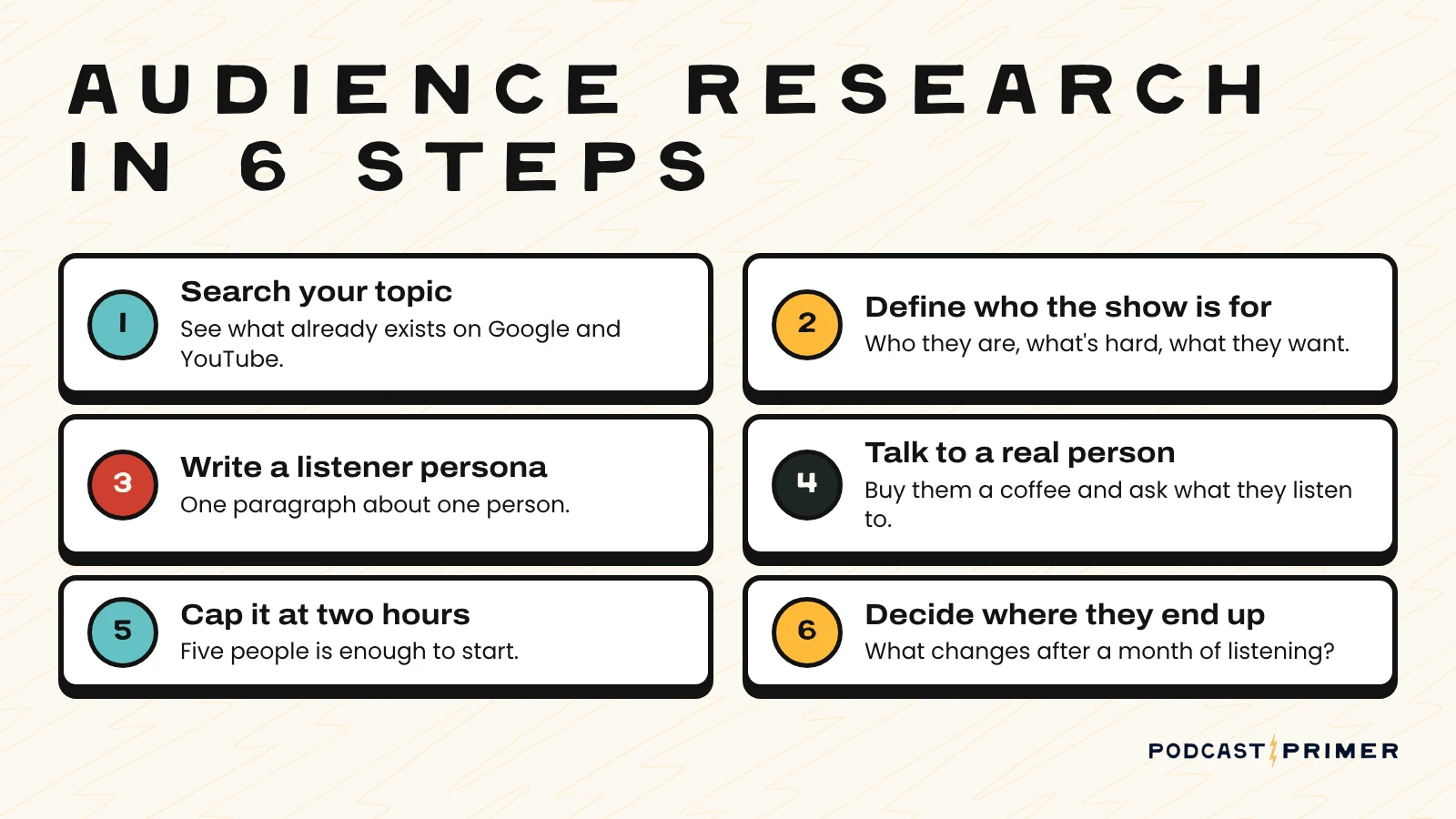
- Six steps, from first search to first conversation
- A listener persona template and a short survey you can copy
- What to do differently if the show is for your business
- Free places to look
- How to check your guess after you launch
- Mistakes to avoid
- Common questions
Why audience research is worth two hours
Think of a brand you love. Chances are its message felt like it was written for you. That's audience research at work.
A podcast is the same. When you know who's listening, deciding what to cover, who to invite, and how to talk gets much easier.
Remember: you're not looking for the biggest audience. Two hundred of the right listeners beat fifty thousand of the wrong ones.
Step 1: Search your topic
Before you define your listener, see what's already out there.
- Search your topic on Google and YouTube.
- Add "podcast" to the end and search again.
- Ask yourself: what would my listener type if they were looking for this?
You're looking for three things:
- How much is out there. Lots of content means people care about the topic. Very little can mean an opening.
- Who the top shows are. Check when they last published. Old or abandoned shows leave room for a fresh one.
- What's missing. An angle, a subtopic, or a kind of listener nobody is talking to.
Step 2: Define who the show is for
Answer three questions:
- Who am I making this for? Their age, job, where they are in life, and what they already read, watch, and listen to.
- What problems do they face? Day to day, at work, and around your topic.
- What do they want? In the next few months and in the long run.
If you already have someone in mind, a friend or colleague who'd be perfect for the show, use them. A real person is easier to make a show for than a category.
Step 3: Write a listener persona
If you can't think of a real person, write one. Give them a name, a job, a home life, a current challenge, and a goal. Then put it in a short paragraph.
Here's an example:
Sarah is a 35-year-old marketing manager and mother of two. She's considering starting a side business but feels overwhelmed by conflicting advice online. She wants practical strategies she can use in her limited free time to build a steady income without giving up her evenings.
Your persona doesn't have to be perfect. It's a starting guess that you'll check in the next step.
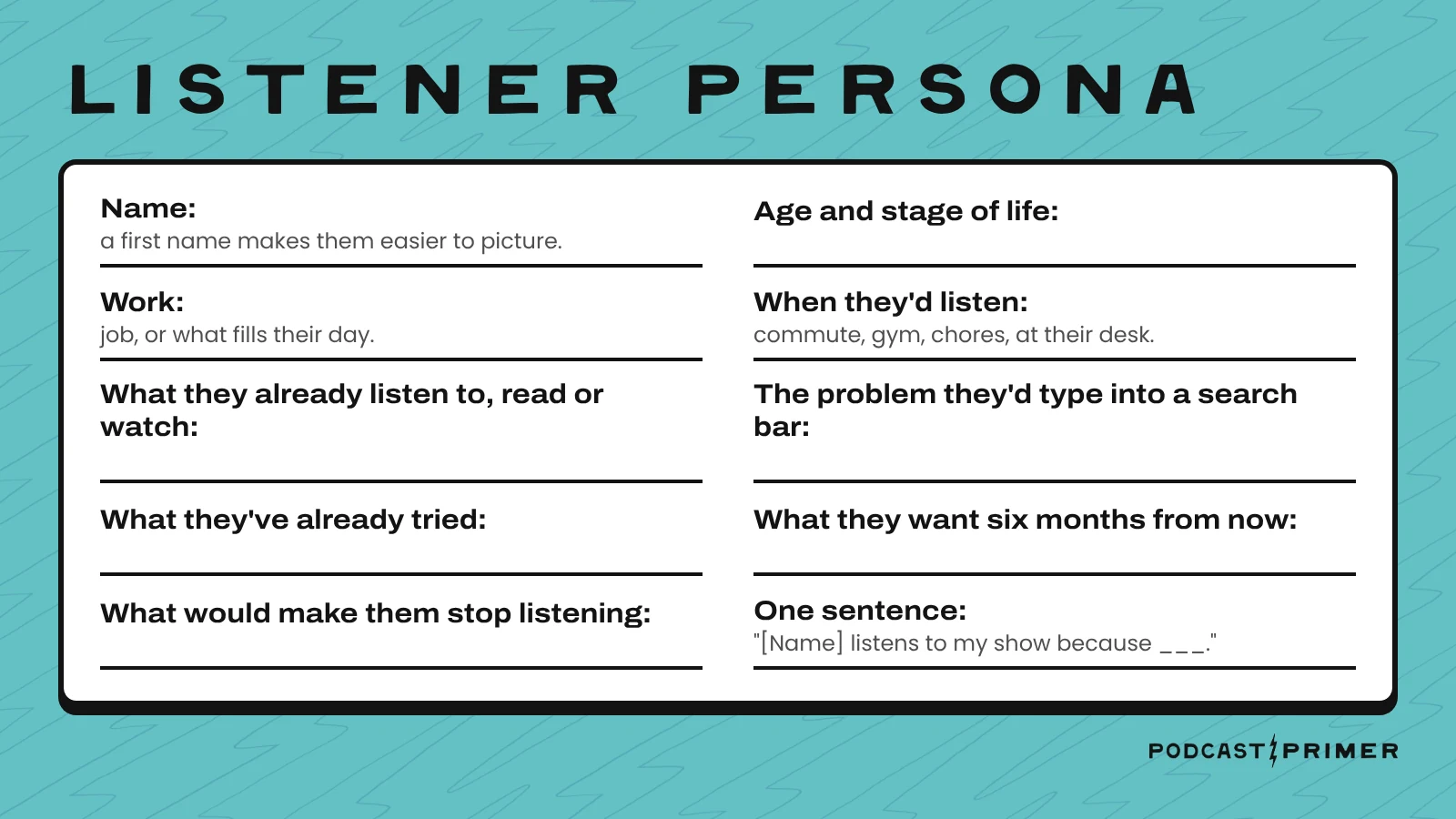
Listener persona template
Copy this and fill in the blanks. One line each is enough.
- Name: a first name makes them easier to picture.
- Age and stage of life:
- Work: job, or what fills their day.
- When they'd listen: commute, gym, chores, at their desk.
- What they already listen to, read or watch:
- The problem they'd type into a search bar:
- What they've already tried:
- What they want six months from now:
- What would make them stop listening:
- One sentence: "[Name] listens to my show because ___."
If you can fill in that last line without hesitating, you know your audience well enough to start.
Step 4: Talk to a real person
Find someone who looks like your ideal listener and ask for 20 minutes. Buy them a coffee or meet on a video call. What you learn is worth far more than the coffee.
Questions to ask:
- What podcasts do you listen to now?
- What do you like most about your favorite shows?
- What topics do you wish someone would cover?
- Who would you love to hear interviewed?
- What's your biggest challenge right now?
- What would stop you from listening to a podcast?
Step 5: Cap it at two hours
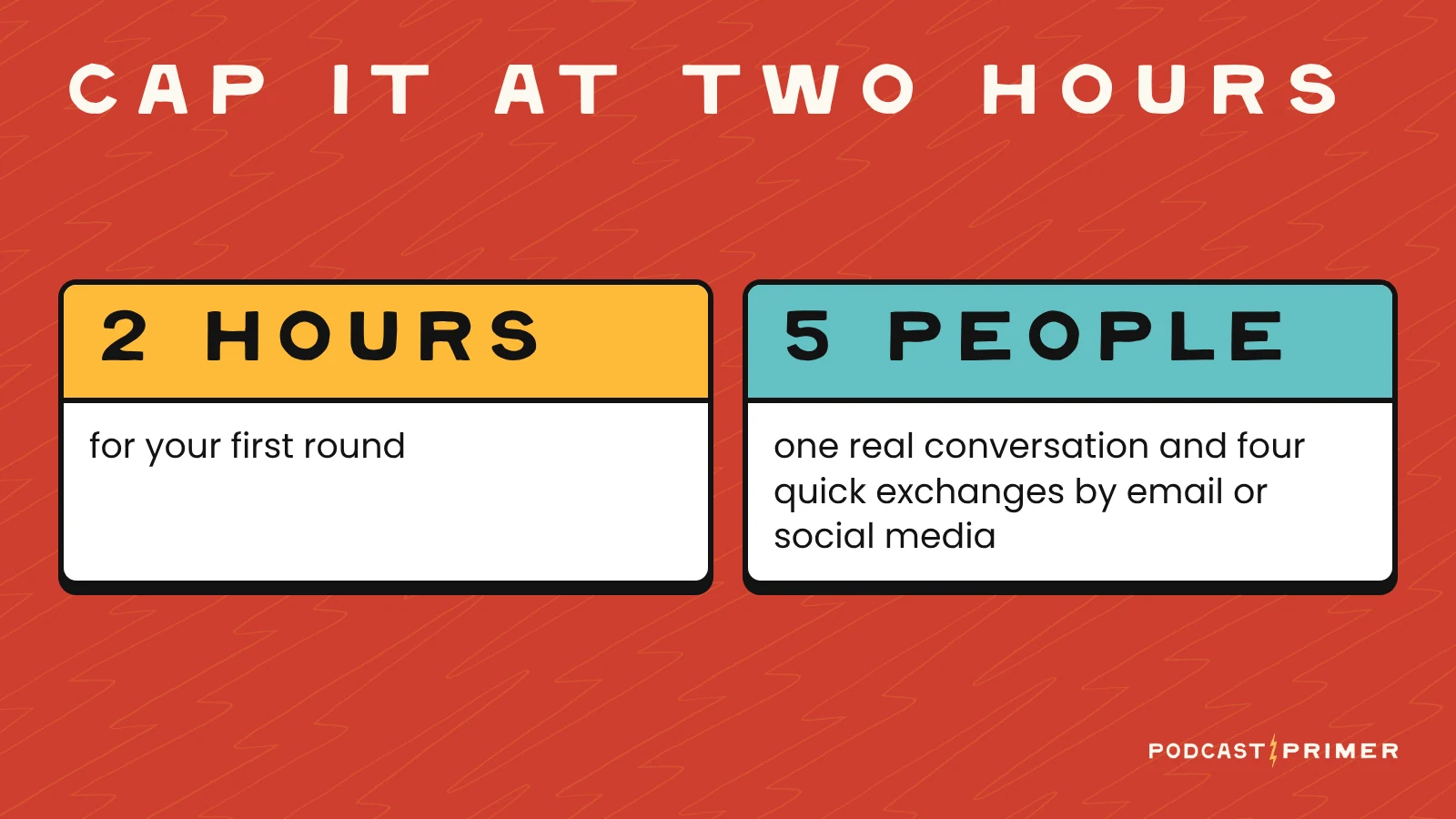
Research can turn into a way of putting off the show. So set a limit:
- Two hours for your first round
- Five people: one real conversation and four quick exchanges by email or social media
If you don't get to five, don't worry. One good conversation will teach you a lot.
Step 6: Decide where your listener ends up
The shows people stay with change something for them. Ask yourself:
- Where is my listener when they first find the show?
- Where do I hope they'll be after a month or two of listening?
- What will be better for them?
Write the answer in one sentence. It becomes the promise of your show.
If the show is for your business, start with your customers
A business podcast has a head start: you already know some of your listeners. They're the people who buy from you.
- List your ten best customers. Look for what they have in common: role, company size, the problem that brought them to you.
- Ask your sales or support team which questions come up every week. Each one is an episode.
- Read your own inbox. The words customers use to describe their problem are the words to use in your titles.
- Pick the listener who can say yes. If you sell to marketing directors, make the show for marketing directors, even if a wider audience would be bigger.
Reality check: for a business show, 200 listeners who could become customers are worth more than a big audience that never will.
A short listener survey you can send
If you have an email list or social following, five questions is plenty. Keep it to two minutes.
- What's your role, in a few words?
- What's the hardest part of [your topic] for you right now?
- Which podcasts, newsletters or channels do you already follow on this?
- When do you usually listen to podcasts?
- What's one question you'd love an expert to answer?
You don't need a hundred replies. Ten honest answers will show you a pattern.
Free places to do podcast audience research
- YouTube comments on videos about your topic
- Reddit communities and Facebook Groups
- LinkedIn Groups, for professional topics
- Google Trends, to see whether interest is rising or falling
- Your own email list or social followers, if you have them
- Local meetups and events
You don't have to use all of these. Pick the two where your listener is most likely to be.
Mistakes to avoid
- Skipping the conversation. A persona you never checked with a real person is a guess.
- Researching forever. Set the two-hour limit and move on at about 80% sure.
- Aiming at everyone. "Everyone" is not an audience.
- Doing it once. Check in with listeners again as the show grows.
After you launch: check your guess against the numbers
Your persona is a guess until real people listen. Once you have a few episodes out, look at what your hosting platform, Spotify for Creators and Apple Podcasts Connect tell you about who's listening and how far they get.
Ask yourself:
- Do the listeners look like the person you wrote down?
- Which episodes do people finish, and which do they drop early?
- What do the replies, reviews and messages have in common?
If the audience turns out to be someone slightly different, that's useful. Adjust the persona and keep going.
Podcast audience FAQ
How do I find my podcast's target audience?
Start with the person you most want to help. Describe them, search for what they'd search for, and talk to one person who fits.
What's the difference between a target audience and a niche?
Your niche is the topic. Your target audience is the person. "Personal finance" is a niche. "Nurses in their first five years who want to pay off student loans" is a target audience.
What is a listener persona?
A short description of one ideal listener: who they are, what's hard for them, and what they want. Some people call it a listener avatar.
How specific should my podcast audience be?
Specific enough that you can name three real people who fit. If you can't, narrow it down.
Your next step
Block two hours this week. Do the search, write the persona, and send one message asking someone for 20 minutes.
Once you know who the show is for, you're ready to choose your topic and do some keyword research. The free Podcast Primer workbook has space for all of it.
Rather hand this off?
Podcast Primer is made by Holistic Media. We plan, record, edit and publish podcasts for brands, so your team only has to show up and talk.
See how it works →